
Ranking but not growing? These SaaS... Read more






Key Takeaways
- SaaS SEO mistakes often hide behind growing traffic and improving rankings.
- Rankings without intent alignment don’t drive demos or revenue.
- Product and use-case pages matter more than blogs for conversion.
- Internal links should move users through evaluation, not trap them at awareness.
- SaaS SEO works when content decisions improve buyer journeys.
Why SaaS SEO Mistakes Are Hard to Spot Early
“I have audited SaaS sites where traffic doubled in six months, dashboards looked healthy, and leadership still asked why demos stayed flat.”
That moment usually triggers confusion, not urgency.
Because on paper, SEO looks like it’s doing its job.
SEO Relies on Lagging Indicators
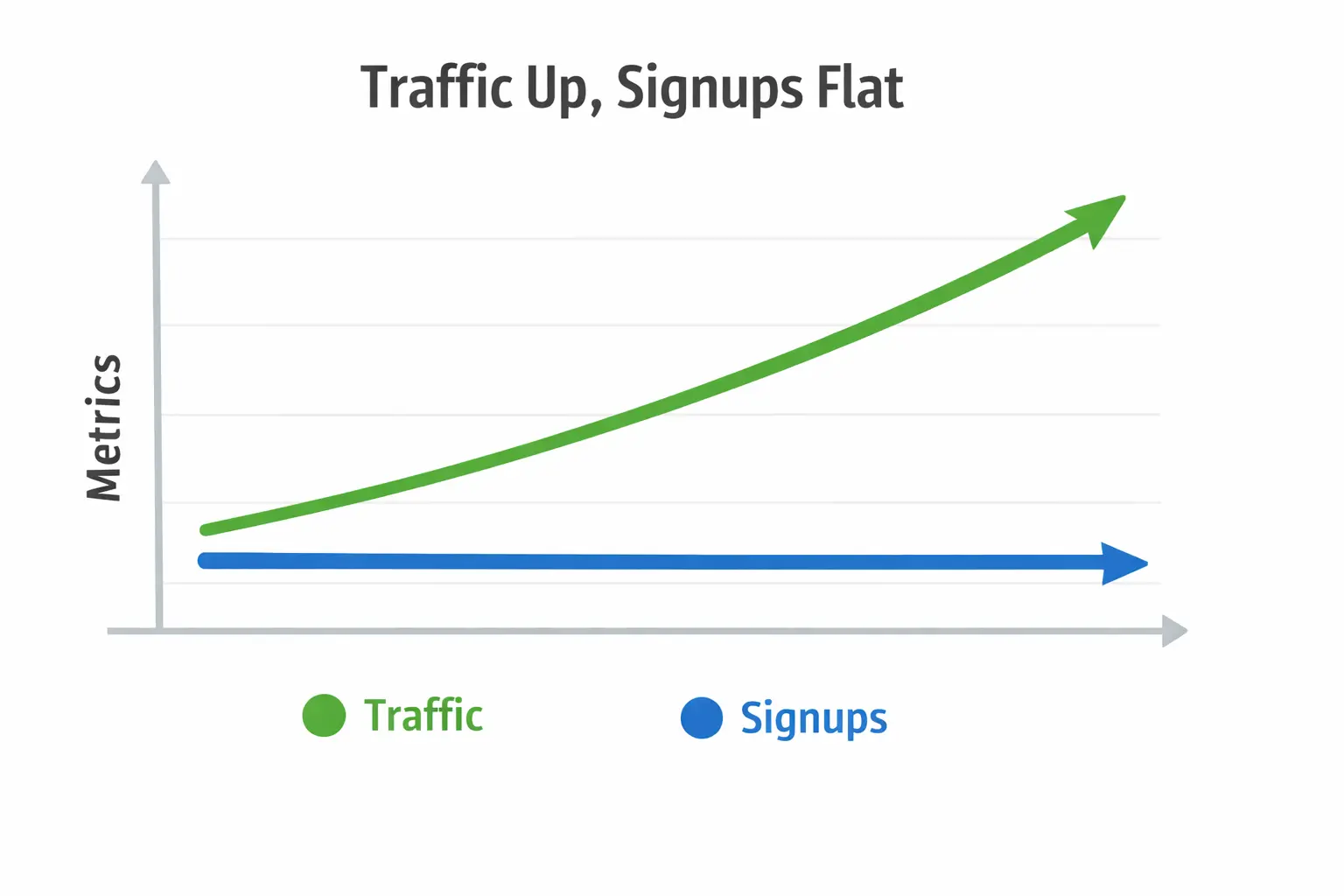
Most SaaS teams judge SEO success using metrics that respond after decisions are made.
Traffic growth, keyword movement, and impressions confirm activity, not impact.
By the time pipeline issues show up, the SEO strategy has already been running for months.
What hides the problem:
- Rankings improve before conversions do
- Traffic grows faster than product-qualified leads
- Revenue signals trail SEO execution by a full quarter (or more)
📊 Vanity Metrics Create a False Sense of Progress
Rankings feel tangible and easy to celebrate.
They’re also dangerously incomplete.
You can rank for high-volume keywords and still attract users with zero buying intent.
Common vanity traps include:
- Celebrating page-one wins without checking assisted conversions
- Reporting traffic spikes without segmenting by intent
- Ignoring engagement depth across comparison or pricing-adjacent pages
🚦 Rankings Build Confidence Faster Than They Build Revenue
SEO success creates optimism, and optimism delays scrutiny.
When charts trend upward, teams assume growth will naturally follow.
That confidence suppresses hard questions:
- Are visitors actually evaluating solutions?
- Do pages support mid-funnel decisions?
- Is SEO traffic influencing demos, trials, or sales cycles?
A simple example: you scale blog traffic with informational keywords, but demo requests stay flat because visitors were never problem-aware buyers.
And this is where most SaaS SEO strategies quietly derail—long before anyone calls it a problem.
And in nearly every SaaS SEO audit, this blind spot starts with the same mistake: chasing rankings without aligning them to buyer intent.
Mistake 1: Chasing Rankings Without Intent Alignment
Ranking higher feels like progress.
But when intent is misaligned, those rankings quietly work against growth.
🔹 Traffic Intent vs Product Intent
Not all traffic is created to convert.
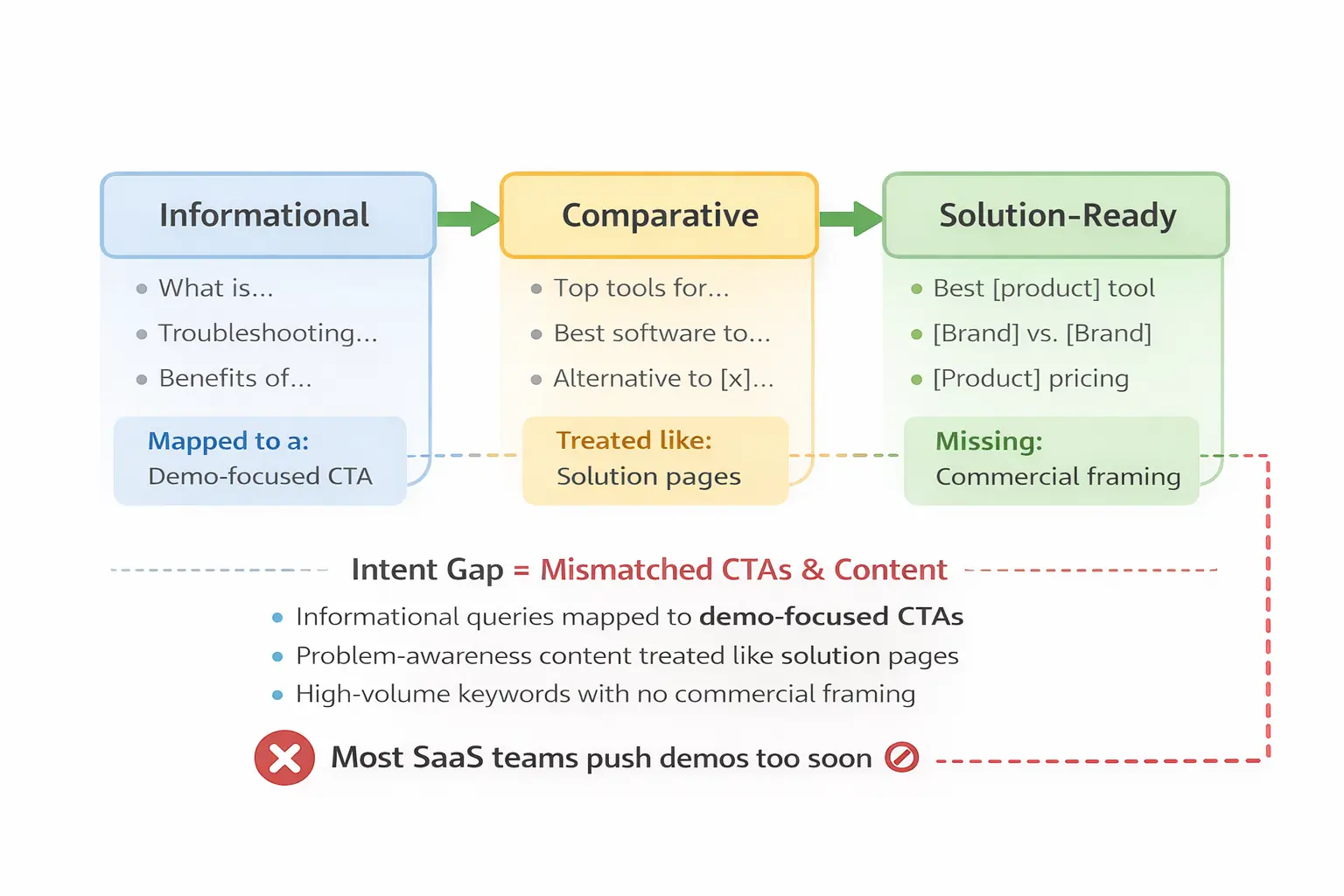
Search intent defines why someone is searching, while product intent defines whether they’re ready for your solution.
Many SaaS teams optimize for keywords that attract curiosity, not consideration.
The result is traffic that reads, scrolls, and leaves without ever evaluating your product.
Typical intent gaps look like this:
- Informational queries mapped to demo-focused CTAs
- Problem-awareness content treated like solution pages
- High-volume keywords with no commercial framing
A simple example: you rank for “how to automate reports,” but visitors want templates, not a paid analytics platform.
When traffic intent and product intent don’t overlap, conversions stall even as rankings climb.
🔹 Why SaaS Blogs Rank but Signups Stall
Google rewards relevance, not revenue impact.
If your content satisfies the query, it can rank regardless of whether it drives business outcomes.
This creates a dangerous illusion of success.
Traffic graphs go up, but trial signups, demo requests, and pipeline influence stay flat.
Common reasons this happens:
- Blog content stops at education without guiding next steps
- CTAs assume buying readiness that doesn’t exist
- Pages lack comparison, differentiation, or use-case depth
You end up attracting readers who aren’t evaluating tools yet.
They consume content, feel helped, and exit—without a reason to move closer to your product.
A quick example: you publish a detailed SEO glossary that ranks well, but zero readers reach your pricing or features pages.
🔹 How to Detect Intent Mismatch Early
Intent misalignment is easiest to fix before scaling content.
You just need to look beyond surface metrics.
Early warning signals include:
- High organic traffic with low assisted conversions
- Long time-on-page but no CTA interaction
- Blog pages outranking core solution pages
You should also review SERPs manually.
If top results are guides, definitions, or checklists, pushing demos aggressively is a mismatch.
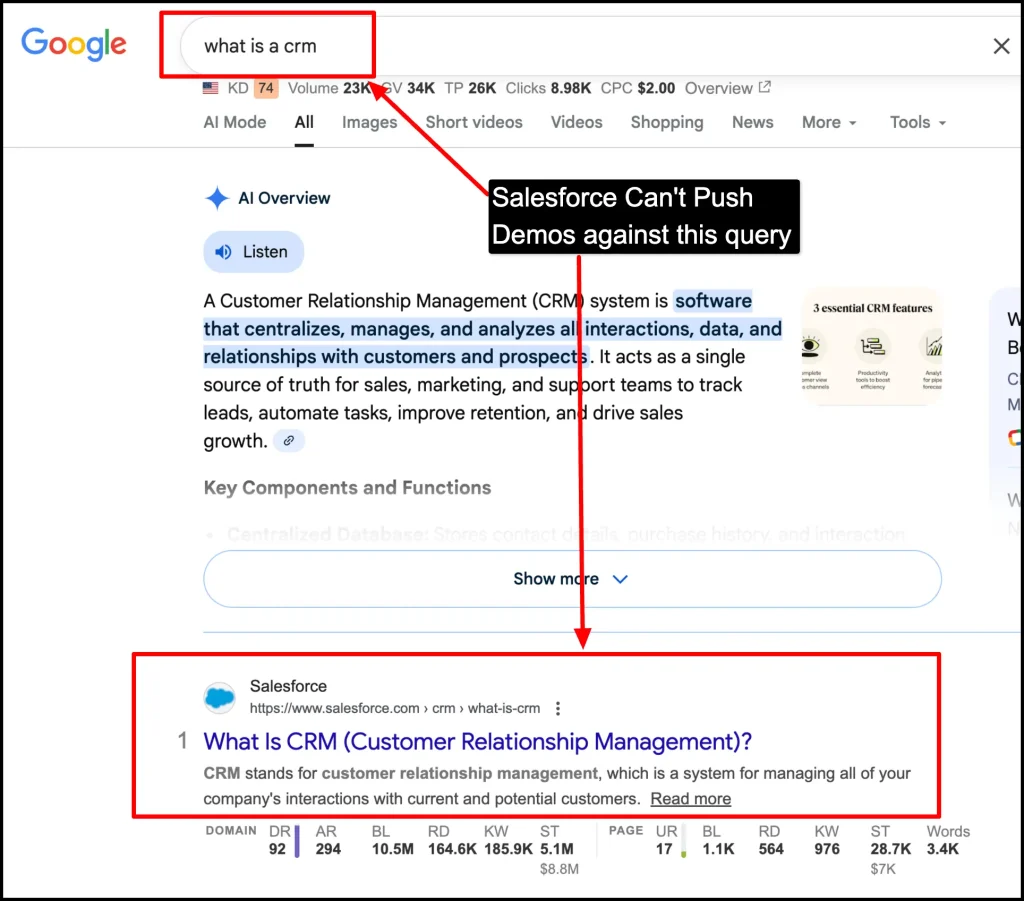
The fix isn’t ranking less.
It’s aligning content depth, CTAs, and messaging to where the reader actually is in their decision journey.
If this feels familiar, your SaaS content likely has an intent mismatch.
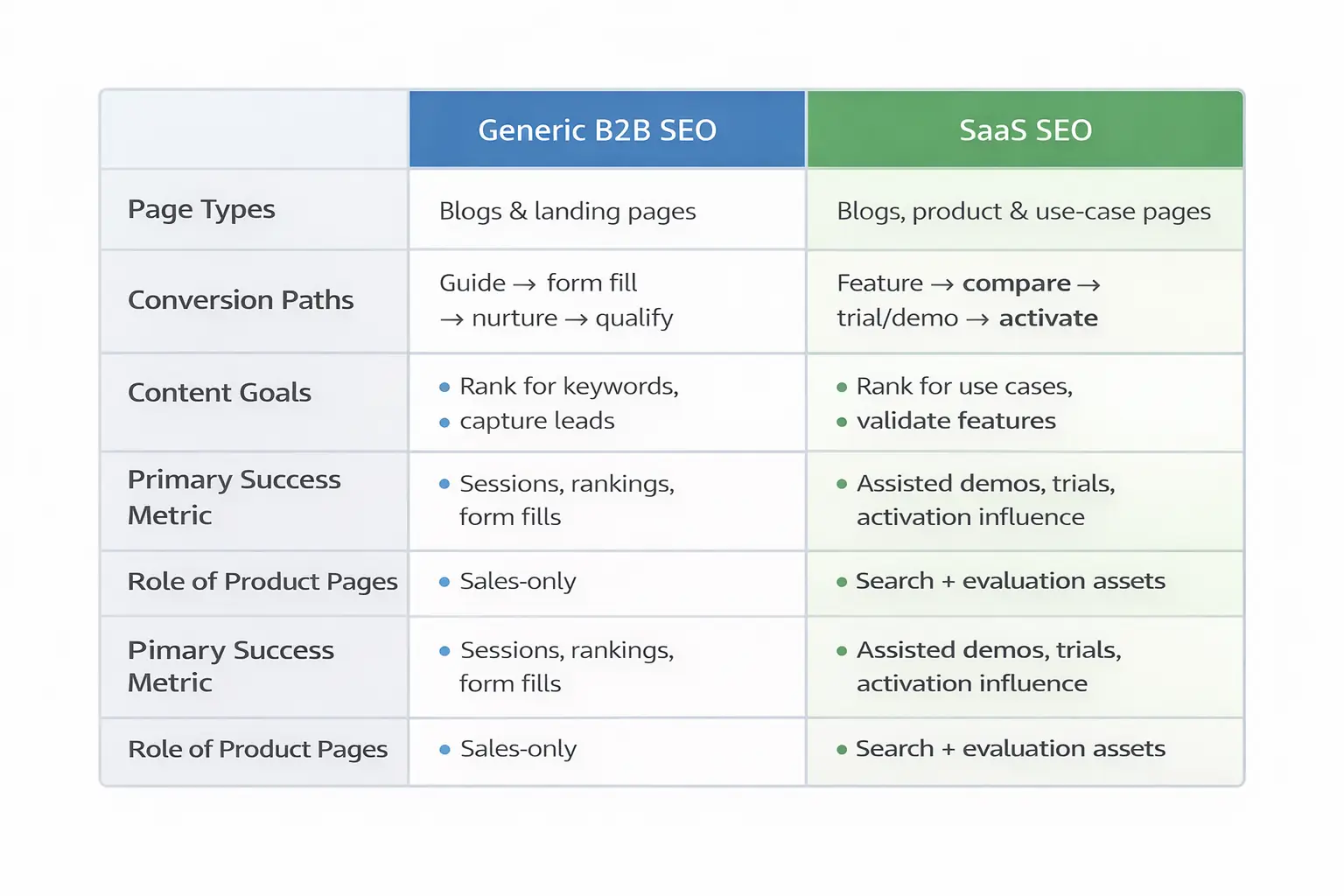
Mistake 2: Treating SaaS SEO Like Generic B2B SEO
“Most SEO advice assumes the website is the business. In SaaS, the product is the business.”
That gap is where many high-ranking SaaS sites quietly lose growth.
They apply B2B SEO playbooks built for services, not products that need to be experienced before they’re bought.
🔹 Why SaaS Pages Behave Differently
In classic B2B, a blog post can be the conversion engine.
In SaaS, content only works if it moves users closer to the product.
SaaS buyers don’t convert after reading once.
They research features, integrations, limitations, pricing, and real-world use cases across multiple sessions.
What makes SaaS SEO fundamentally different:
- SEO traffic influences trials, not instant purchases
- Product education is part of the funnel, not a post-signup step
- Feature depth often matters more than keyword breadth
A practical example:
you publish ranking content around “team documentation,” but users still need to understand permissions, templates, and workflows before committing to a tool like Notion.
Generic B2B SEO ignores this evaluation loop.
SaaS SEO must support it intentionally.
🔹 Product Pages Get Ignored in SEO Planning
Most SaaS SEO strategies over-prioritize blogs and underbuild product pages.
Features, integrations, and use-case pages are treated like static sales collateral.
That’s where high-intent demand gets lost.
Common operational gaps:
- Feature pages written for sales calls, not search behavior
- Integration pages missing comparison or problem context
- Use-case pages excluded from internal linking loops
A real-world pattern:
teams rank guides on CRM workflows, but HubSpot’s feature-level pages capture buyers searching with purchase-ready intent.
Another example: you attract traffic for “remote collaboration tips,” but users evaluating tools like Slack never land on searchable feature or integration pages.
When product pages don’t participate in SEO, blogs absorb all attention.
Traffic grows, but evaluation stalls.
SaaS SEO works only when content feeds the product experience.
Treat it like generic B2B SEO, and growth plateaus—quietly but predictably.
Mistake 3: Publishing Content Without a Structural Strategy
Most SaaS blogs don’t fail because of bad content.
They fail because content is published as isolated assets instead of a system.
You hit publish, traffic trickles in, and the post quietly dies.
No momentum, no compounding value, no funnel movement.
🔹 Flat Blog Libraries vs Connected Systems
A flat blog library treats every post as a standalone win.
Each article targets a keyword, ranks independently, and ends the journey there.
That model doesn’t work for SaaS.
SaaS buyers don’t search once and convert.
They move through problem awareness → solution exploration → product evaluation across multiple queries and sessions.
Flat structures create these issues:
- Informational posts with no logical next step
- High traffic pages that never touch product content
- Orphan blogs that rank but don’t influence revenue
In contrast, connected systems are intentional.
They cluster topics, guide readers forward, and reinforce authority through internal relationships.
A blog post shouldn’t just rank.
It should hand the reader off to the next stage of intent.
🔹 Internal Links as Intent Flow
Most teams treat internal links as SEO hygiene.
In SaaS, internal links are behavior design.
They decide where users go next and what they evaluate.
Without them, readers stop exactly where Google drops them.
Strategic internal linking does three things:
- Moves users from education to evaluation
- Signals topical depth to search engines
- Pushes authority toward product and money pages
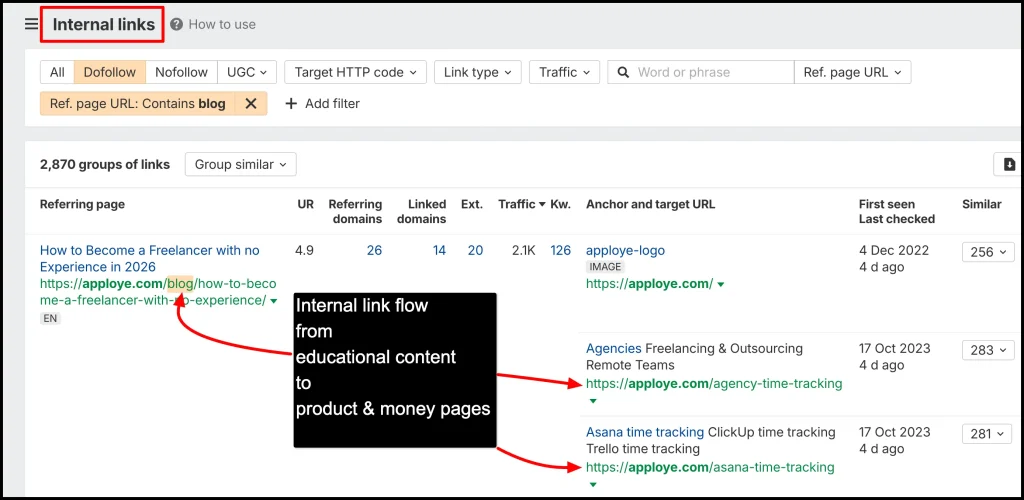
When internal links are missing or random, intent stalls.
Traffic accumulates at the top of the funnel with nowhere to go.
A connected structure plans links before content is written.
Every post knows what it supports, what it feeds, and where it escalates.
Example:
You read onboarding guides on Intercom’s blog, then flow into product, use-case, and integration pages—turning learning into evaluation instead of dead-end traffic.
Content scales when structure exists.
Without it, even great SaaS content stays stuck at awareness.
Mistake 4: Ignoring Content Decay and SERP Evolution
“Pages do not fail overnight. They slowly stop being chosen.”
That’s how most SaaS content loses impact.
Not with a ranking crash, but with fewer clicks, fewer evaluations, and shrinking influence.
🔹 Why Old SaaS Content Quietly Stops Working
SaaS content ages faster than most teams expect.
Interfaces change, features evolve, pricing shifts, and use cases mature.
But the content stays frozen.
Search engines notice when pages stop reflecting reality.
Users notice even faster.
Common decay signals in SaaS content include:
- Outdated screenshots that no longer match the product
- Feature descriptions misaligned with current positioning
- Examples that reference old workflows or integrations
A practical example:
you rank for onboarding best practices, but readers evaluating tools like Userpilot bounce when screenshots don’t match the current UI.
The page still ranks. It just stops converting.
Content decay isn’t about freshness dates.
It’s about relevance to how buyers evaluate today.
🔹 How AI Answers Change Evaluation
AI-driven SERPs reduce tolerance for shallow content.
If your page doesn’t add clarity or experience, it gets skipped.
Searchers now arrive with context pre-filled.
They expect deeper comparisons, real workflows, and product-specific insights.
AI reshapes evaluation by:
- Answering basic questions instantly
- Surfacing summaries before users click
- Prioritizing pages with firsthand signals
For example, someone researching live chat tools may get instant comparisons before ever clicking pages from platforms like Intercom.
If your content only repeats what AI already shows, it loses relevance.
SaaS SEO now demands updates that reflect product reality, user behavior, and evolving SERP formats.
Pages don’t disappear when ignored.
They just stop being chosen—and growth quietly follows.
Mistake 5: Fixing Everything at Once Instead of Prioritizing
When SaaS SEO underperforms, the instinct is to fix everything.
More content, more links, more updates, more tools.
That reaction feels productive.
It’s usually what slows growth the most.
🔹 High-Impact vs Low-Impact SEO Mistakes
Not all SEO problems deserve equal attention.
Some block revenue directly, while others only polish the surface.
High-impact mistakes interfere with evaluation and conversion.
Low-impact mistakes mostly affect visibility without changing outcomes.
High-impact SaaS SEO issues include:
- Product and use-case pages not ranking for buyer-intent queries
- Content attracting the wrong intent stage
- Internal links failing to move users toward trials or demos
Low-impact distractions often include:
- Minor on-page tweaks on low-intent blogs
- Chasing incremental keyword position gains
- Refreshing content that already converts well
The danger is treating them the same.
Teams spread effort thin, fix nothing fully, and see no measurable lift.
A real pattern:
you rewrite ten blog posts instead of fixing two feature pages that influence 60% of demo-assisted traffic.
🔹 A Simple SaaS SEO Prioritization Lens
SaaS SEO should be prioritized by business leverage, not effort.
Ask how closely an issue connects to revenue behavior.
Use this simple lens before acting:
- Does this page influence trials, demos, or pipeline?
- Is the search intent evaluative or purely informational?
- Will fixing this reduce friction in the buyer journey?
If the answer is no, it’s not urgent.
For example, improving comparison and integration pages often outperforms publishing new top-of-funnel content.
That’s why platforms like HubSpot prioritize searchable product surfaces over endless blog expansion.
SEO progress comes from sequencing, not volume.
When you fix the few things that matter most first, everything else compounds faster.
Prioritization doesn’t slow SEO.
It’s what finally makes it work.
🧪 How to Audit Your SaaS SEO Without Overcomplicating It
Most SaaS teams avoid SEO audits because they feel heavy.
In reality, a useful audit can be done in 2–3 hours if you focus on the right layers.
This isn’t about crawling everything.
It’s about identifying what blocks growth first.
🔹 Layer 1: Intent Alignment
Start by checking whether pages match why users are searching.
Use Google Search Console → Performance → Pages.
Look for pages with:
- High impressions but low clicks
- High clicks but no downstream conversions
Then manually review the SERP for each page.
If Google ranks guides but your page pushes demos, you’ve found an intent mismatch.
⏱️ Time: ~30 minutes
🔹 Layer 2: Page Roles
Every page should have a job.
Blogs educate, use-case pages evaluate, product pages convert.
Use Ahrefs → Top Pages report to identify:
- Blogs ranking higher than product pages
- Feature pages with impressions but weak structure
If a page doesn’t clearly support awareness, evaluation, or conversion, it’s underperforming by default.
⏱️ Time: ~30–40 minutes
🔹 Layer 3: Internal Links
Internal links decide where intent flows.
Open Ahrefs → Site Audit → Internal Linking or use Screaming Frog.
Check:
- Blogs with traffic but zero links to product pages
- Orphaned use-case or integration pages
If users can’t move forward, SEO stops at awareness.
⏱️ Time: ~30 minutes
🔹 Layer 4: Conversion Support
Finally, validate outcomes.
Use Google Analytics (GA4) → Landing Page report.
Ask:
- Do organic pages assist demos or trials?
- Are CTAs aligned to intent stage?
⏱️ Time: ~30–40 minutes
You don’t need a perfect audit.
You need clarity on what to fix first.
🏁 Final Takeaway: SaaS SEO Works When Decisions Improve
SaaS SEO doesn’t fail because rankings don’t move.
It fails when decisions don’t improve after users arrive.
Growth happens when content guides evaluation, not just discovery.
This problem becomes clearer when you look at SaaS content as a system, not isolated posts.
If you want SEO to influence demos and pipeline, start designing content paths—not publishing more pages.
FAQs
1. What are the most common SaaS SEO mistakes?
The most common SaaS SEO mistakes include chasing rankings without intent alignment, over-investing in blogs while ignoring product pages, weak internal linking, and treating SEO as a traffic channel instead of a growth system.
These mistakes don’t kill rankings—they quietly kill conversions.
2. Why does my SaaS blog get traffic but no signups?
Because traffic alone doesn’t equal buying intent.
Most SaaS blogs rank for early-stage informational queries, but they fail to guide users toward evaluation, trials, or demos through CTAs, internal links, or product-led context.
3. Is SaaS SEO different from B2B SEO?
Yes, fundamentally.
B2B SEO often assumes content is the product, while SaaS SEO must support product discovery, feature evaluation, and activation across multiple sessions before conversion happens.
4. How long does it take to fix SaaS SEO issues?
Initial clarity usually comes within 30–60 days.
Meaningful growth impact—better demo quality, higher assisted conversions, stronger pipeline—typically shows within 90–120 days after fixing intent, structure, and product page visibility.
5. Should SaaS startups focus on blogs or product pages first?
Start with product, use-case, and integration pages.
Blogs scale awareness, but product pages capture intent—without them, traffic grows while revenue stays flat.
About The Author

Dhruv Mehta
Dhruv Mehta specializes in SaaS CRM, solving link-buying challenges with high-quality, bottom-of-the-funnel links through hyper-personalized outreach. He’s also passionate about sharing tried-and-tested, easy-to-implement SaaS SEO and link-building insights on LinkedIn. Currently, he's on a mission to build 45 SaaS backlinks in 45 days.

SaaS Link Building Playbook for Faster SEO Wins
Learn proven SaaS link building tactics... Read more

How to Choose the Right White Label Link Building Partner for Your SaaS SEO Agency
Learn how to pick a trusted... Read more
Forum Backlinks in 2026: Strategy, Risks & Truth
Uncover the real value of forum... Read more

13 Cold Email Tweaks That Improved Backlink Outreach (Backed by Experts)
Compare the best white label link... Read more
Domain Rating vs Domain Authority – What SEOs Should Focus On
Learn the real differences between Domain... Read more
Leading White Label Backlink Services: Ranked & Reviewed
Compare the best white label link... Read more
Relevant Links Guide: Master Contextual Backlinks Today
Learn how to build relevant links... Read more

Manual Link Building in 2025: A Human-First Guide
Learn manual link building in 2025... Read more
Contextual Link Building in 2025: A Practical SEO Guide That Works
Discover why contextual backlinks outperform traditional... Read more

Mastering International Link Building in 2025
Boost your global SEO with backlinks... Read more

Beyond DR: Real Link Building Metrics That Actually Work
Discover 9 expert-backed link building metrics... Read more

10 Proven Ways to Sell Backlinks and Earn $30K a Year
Discover 10 proven ways to sell... Read more

How To Earn Natural Backlinks Without Cold Emails
Earn natural backlinks by creating valuable... Read more

The Ultimate Guide to Organic Link Building in 2026: Future-Proof Your SEO
Master organic link-building in 2025 with... Read more

Top AI-Powered Link Building Trends for 2025 [From 15 Experts]
Discover 2025’s top AI-powered link building... Read more

Link Prospecting Guide: Find High-Quality Backlinks
Step-by-step link prospecting guide to find... Read more

Inbound Link: What it is & How It Affects Your SEO Rankings?
Learn what an inbound link is,... Read more

Backlink Management Guide: Unlocking Top Tools and Strategies
Looking for a comprehensive guide on... Read more

CTR Manipulation: Discover Ethical SEO Alternatives
Understand CTR manipulation vs. white hat... Read more

Niche Relevant Backlinks: Comprehensive Guide (2025)
Unlock the power of niche relevant... Read more

White Label Link Building 101: A Guide for SEO Agencies
Enhance your client's SEO with white... Read more

10+ Niche Driven SEO Strategies to Boost Your Traffic & Revenue
Boost traffic and revenue with niche... Read more

How to Check Who Links to My Site Or Any Site for Better SEO?
Discover who's linking to your site... Read more

What Are Editorial Links? (+ How to Earn Them)
Learn what editorial links are and... Read more

Link Building Checklist (2025): Smart Strategies for SEO Pros
Unlock the secrets to a successful... Read more

20+ Link Building Benefits for SEO Mastery and Growth
Explore the impact of reciprocal links... Read more
Unlocking the Power of Reciprocal Links in 2025: Strategies for SEO Success
Explore the impact of reciprocal links... Read more
13 Link Building Challenges & How to Overcome Them
Navigate through the complexities of link... Read more

16 Link Building Mistakes to Avoid in 2024
Learn the key 16 link building... Read more

What Are PBN Backlinks? (And Why You Shouldn’t Use Them)
Uncover the essence of a backlink... Read more
![Backlink Profile: Analysis + [2 Perfect Examples]](https://clickass.io/wp-content/uploads/2024/01/Examples-of-Perfect-Backlink-Profile3-1.webp)
Analyzing Your Backlink Profile for SEO & 2 Perfect Examples
Uncover the essence of a backlink... Read more
10 Ways to Index Backlinks Faster in 2024
Explore top methods for quick backlink... Read more

Nofollow vs. Dofollow Backlinks: Understanding Their SEO Implications
Learn about the differences between dofollow... Read more

Tiered Link Building: Everything You Need to Know
Do you wonder how tiered link... Read more

What is Link Equity and How Is It Determined?
Explore the concept of link equity... Read more
Link Building 101: Master The Basics and Beyond
Cultivate online authority with my expert... Read more
The Power of Backlinks: Why They Are Essential for SEO Success
Learn how backlinks can boost your... Read more

Link Insertion: How to Do it with $0 Investment?
Is your website looking for that... Read more

Everything You Need to Know About Link Farming
Explore to learn what link farming... Read more
9 Underrated Techniques to Get High Authority Backlinks in 2024
Are you looking to improve your... Read more

Doorway Page Explained: Ultimate Effects on SEO And Rankings
Learn what doorway pages are &... Read more

Top of Funnel Marketing For SaaS: Strategies, Measurement, and Examples
Are you looking to create brand... Read more

Link Building Outsourcing: The Definitive Guide [2023]
Does the idea of link building... Read more

8 Cost-Effective Ways to Get You Higher Search Engine Rankings
See how to make the most... Read more

An Ultimate Guide to Growth Marketing
Learn about the nuances of growth... Read more